
- Availability & Price
- Search SKU
Filter by attributes
- Cracking Pressure
- Flow Rate
- Maximum Inlet Pressure Rating
- Seal Material
- Sealed Pilot Included
Filter by manufacturer


Pilot Piston Style Pilot Operated Check Valves
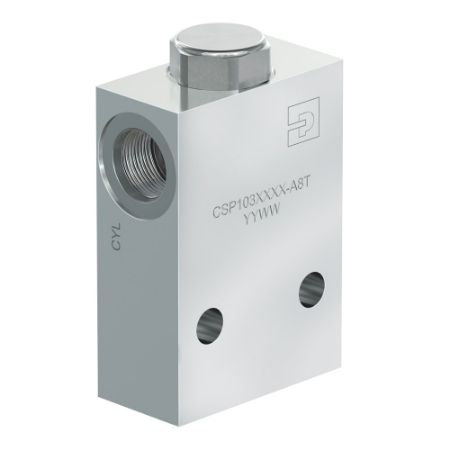
*PRODUCT IMAGE IS REPRESENTATIVE PROVIDED BY THE MANUFACTURER. DO NOT MAKE BUYING DECISIONS SOLEY BASED ON THE IMAGE. PLEASE VERIFY SPECIFICATIONS MEET YOUR REQUIREMENTS.
Parker’s reliable pilot piston style P.O. check valves are designed for critical applications where safety and load holding is required and flows from 38 to 226 lpm (10 to 60 gpm) and pressures up to 350 bar (5,000 psi) are needed. These valves are generally used in conjunction with linear actuators across several markets within mobile or industrial hydraulics, such as aerials, material handling, and construction where durable and low leak valves are necessary to keep the machinery and operators safe.
Markets:
• Aerial
• Construction
• Material Handling
• Miscellaneous Mobile
Features/Benefits:
• Spherical poppet for low leakage
• Hardened precision ground parts for durability
• “D”-Ring design eliminates back-up rings
• Optional sealed pilot piston
Applications:
• Load holding without fine metering
Additional Technical Insight:
The CSP(H) series uses a standard pilot piston and a standard Parker check valve in an assembled body. At rest the check valve remains seated, blocking flow from exiting the actuator port and locking the circuit in place. When pressure and flow are opened to the valve inlet, the check valve will allow free flow to the actuator. The valve assembly also utilizes an internal pilot piston with a 3:1 or 4:1 ratio. When sufficient pressure is applied to the pilot port, the piston will respond quickly and will shift against the return check. This action mechanically pilots the valve open, unlocking the circuit, to allow return flow to pass through the valve from the actuator back to tank. When system pressure is shut off to the valve, the valve will return to the holding condition restricting actuator movement and locking the system in place. These valves are ideal for load holding applications, where metering conditions are not required.
Read More...Markets:
• Aerial
• Construction
• Material Handling
• Miscellaneous Mobile
Features/Benefits:
• Spherical poppet for low leakage
• Hardened precision ground parts for durability
• “D”-Ring design eliminates back-up rings
• Optional sealed pilot piston
Applications:
• Load holding without fine metering
Additional Technical Insight:
The CSP(H) series uses a standard pilot piston and a standard Parker check valve in an assembled body. At rest the check valve remains seated, blocking flow from exiting the actuator port and locking the circuit in place. When pressure and flow are opened to the valve inlet, the check valve will allow free flow to the actuator. The valve assembly also utilizes an internal pilot piston with a 3:1 or 4:1 ratio. When sufficient pressure is applied to the pilot port, the piston will respond quickly and will shift against the return check. This action mechanically pilots the valve open, unlocking the circuit, to allow return flow to pass through the valve from the actuator back to tank. When system pressure is shut off to the valve, the valve will return to the holding condition restricting actuator movement and locking the system in place. These valves are ideal for load holding applications, where metering conditions are not required.
| Action | Part No. | Availability | Partner Available | Price | Maximum Operating Temperature | Configuration | Connection Type | For Fluid Type | Division | Cavity Size | Operation Type | Operating Temperature | Division | Body Material | Sealed Pilot Included | Minimum Operating Temperature | Maximum Flow Rate | Leak Rate | Mounting Type | Connection Size | Seal Material | Actuation Type | Flow Rate | Function | Cracking Pressure | Pilot Pressure Ratio | Valve Material | Weight | Flow Direction | Maximum Inlet Pressure Rating | Maximum Kinematic Viscosity | Filter Efficiency Rating | Maximum Operating Pressure | Maximum Inlet Pressure Rating | Seal Material | Sealed Pilot Included | Flow Rate | Cracking Pressure |
|---|---|---|---|---|---|---|---|---|---|---|---|---|---|---|---|---|---|---|---|---|---|---|---|---|---|---|---|---|---|---|---|---|---|---|---|---|---|---|
| CSPH103A20-8T | Quote Required | TBD | 200 | Pilot Piston Style | SAE | Mineral-based Hydraulic Fluids | Hydraulic Valve Systems Division | C10 | Automatic | -35 to 200 | Hydraulic Systems Division | Steel | Yes | -35 | 16 | Internal (max): 2 Dpm (0.13 cc/min) across Check Valves | Line Mounted | -8 | D-Ring (Standard) | Pressure Sensing | 16 | Single Pilot Operated | 20 | 4:1 | Steel (all parts) | 2.77 | Check Flow Cylinder to Valve | 5000 | 45-2000 SSU (6 to 420 cSt) | ISO 4406 18/16/13 | 5000 | 5000 PSI, 350 BAR | D-Ring (Standard) | Yes | 16 GAL/MIN, 60 L/MIN | 20 PSI, 1.4 BAR | ||
| CSPH103P-8T | Quote Required | TBD | 200 °F | Pilot Piston Style | SAE | Synthetic Hydraulic Fluids | Hydraulic Cartridge Systems Division | C10 | Automatic | -37 to 93 °C | Hydraulic Systems Division | Steel | No | -37 °C | 60 L/min | 312 Cc/min across Pilot Piston (no seals) | Line Mounted | -8 | D-Ring (Standard) | Pressure Sensing | 60 L/min | Single Pilot Operated | 0.3 bar | 4:1 | Hardened Steel | 1.25 kg | Check Flow Cylinder to Valve | 350 bar | 45-2000 SSU (6 to 420 cSt) | SAE Class 4 | 350 bar | 5000 PSI, 350 BAR | D-Ring (Standard) | No | 16 GAL/MIN, 60 L/MIN | 5 PSI, 0.3 BAR |
