
- Availability & Price
- Search SKU
Filter by attributes
- Actuation Type
- Configuration
- Flow Rate
- Maximum Inlet Pressure Rating
- Seal Material
- Wire Mesh Screen Included
Filter by manufacturer
2 Way Poppet Type Bi-Directional Solenoid Valve
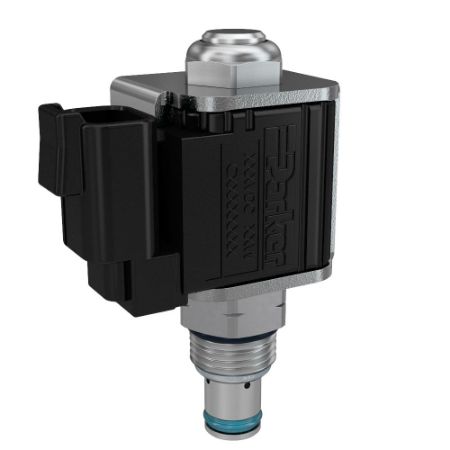
*PRODUCT IMAGE IS REPRESENTATIVE PROVIDED BY THE MANUFACTURER. DO NOT MAKE BUYING DECISIONS SOLEY BASED ON THE IMAGE. PLEASE VERIFY SPECIFICATIONS MEET YOUR REQUIREMENTS.
Parker’s 2-way bi-directional poppet solenoid valves feature a proven design that ensures very low leakage when in the double-blocking position and minimized pressure drop in the free flow position. These valves can operate with hydraulic system flows as high as 285 lpm and pressures up to 350 bar with normally-open or normally closed configurations available. Some of Parker’s 2-way bi-directional poppet solenoid valves contain built-in thermal reliefs set at 36 bar, but all are ideal for unloading and load holding applications that require low poppet style leakage within mobile, industrial, or manufacturing markets.
Markets:
• Miscellaneous Industrial
• Miscellaneous Manufacturing
• Miscellaneous Mobile
Features & Benefits:
• Fast response
• One piece cartridge housing
• Built in thermal relief available
• All external parts zinc plated
Applications:
• Double-blocking applications
• Unloading circuits
• Load holding applications
• Lift circuits
Additional Technical Insight:
Parker’s 2 way poppet valves are pilot operated, low leakage solenoid actuated valves. Similar to a check valve, these valves will block flow in one direction will very low leakage (5 drops per minute, or less). When actuated, these valves allow flow to pass through the valve. These valves are typically selected due to their low leakage characteristics and their ability to meet higher flow requirements. Poppet valves are often used on single operation actuators or in unloading functions. They are available in normally closed and normally open types with fast response versions available.
Parker’s two way, two position poppet valves consist of a main poppet, a pilot piston, a spring, and a solenoid coil.
The normally closed poppet version of these valves will act as a check valve when the valve is de-energized. This blocks flow in both directions while allowing free flow in the reverse direction. When the coil is energized, the poppet is piloted open (lifts) and allows free flow in the previously checked direction, typically from the side of the cartridge out the nose.
The normally open poppet version of these valves, when the coil is de-energized, will allow free flow from the side port of the valve (port 2) out the nose of the valve (port 1). Energizing the coil shifts the poppet to block flow in both directions.
Operation: The normally closed poppet valve is held on its seat by a spring, blocking the pilot flow. This will allow pressure at the inlet port (port 2) to hold the poppet on its seat preventing flow through the valve (port 2 to port 1).
If the nose of the cartridge (port 1) is pressurized enough to overcome the spring force, and pushing the poppet off of its seat, flow will be allowed through port 1 to port 2. When the coil is energized, the pilot poppet is lifted off of its seat, venting the pressure inside the poppet to port 1. This creates a pressure imbalance across the main poppet, therefore lifting the poppet and allowing flow from the side to the nose (2 to 1). Because these valves are pilot operated, a minimal amount of pressure differential is necessary (25-50 psi), along with flow between ports 2 and 1 must be present to overcome the spring and lift the poppet.
The normally open valve pilot is held off its seat by spring force. Pilot flow is vented to port 1, creating a pressure imbalance that moves the main poppet. This differential lifts the poppet allowing flow from the side to nose (2 to 1). Since poppet valves are pilot operated, a minimum amount of pressure differential (25-50 psi) between ports 2 overcomes the spring force to drive the valve pilot and main poppet into their seats, thus blocking flow from port 2 to 1. If the nose of the cartridge (port 1) is pressurized, the pressure will overcome the spring force and solenoid force, pushing the poppet off of its seat, allowing restricted flow through the cartridge (1 to 2).
Read More...Markets:
• Miscellaneous Industrial
• Miscellaneous Manufacturing
• Miscellaneous Mobile
Features & Benefits:
• Fast response
• One piece cartridge housing
• Built in thermal relief available
• All external parts zinc plated
Applications:
• Double-blocking applications
• Unloading circuits
• Load holding applications
• Lift circuits
Additional Technical Insight:
Parker’s 2 way poppet valves are pilot operated, low leakage solenoid actuated valves. Similar to a check valve, these valves will block flow in one direction will very low leakage (5 drops per minute, or less). When actuated, these valves allow flow to pass through the valve. These valves are typically selected due to their low leakage characteristics and their ability to meet higher flow requirements. Poppet valves are often used on single operation actuators or in unloading functions. They are available in normally closed and normally open types with fast response versions available.
Parker’s two way, two position poppet valves consist of a main poppet, a pilot piston, a spring, and a solenoid coil.
The normally closed poppet version of these valves will act as a check valve when the valve is de-energized. This blocks flow in both directions while allowing free flow in the reverse direction. When the coil is energized, the poppet is piloted open (lifts) and allows free flow in the previously checked direction, typically from the side of the cartridge out the nose.
The normally open poppet version of these valves, when the coil is de-energized, will allow free flow from the side port of the valve (port 2) out the nose of the valve (port 1). Energizing the coil shifts the poppet to block flow in both directions.
Operation: The normally closed poppet valve is held on its seat by a spring, blocking the pilot flow. This will allow pressure at the inlet port (port 2) to hold the poppet on its seat preventing flow through the valve (port 2 to port 1).
If the nose of the cartridge (port 1) is pressurized enough to overcome the spring force, and pushing the poppet off of its seat, flow will be allowed through port 1 to port 2. When the coil is energized, the pilot poppet is lifted off of its seat, venting the pressure inside the poppet to port 1. This creates a pressure imbalance across the main poppet, therefore lifting the poppet and allowing flow from the side to the nose (2 to 1). Because these valves are pilot operated, a minimal amount of pressure differential is necessary (25-50 psi), along with flow between ports 2 and 1 must be present to overcome the spring and lift the poppet.
The normally open valve pilot is held off its seat by spring force. Pilot flow is vented to port 1, creating a pressure imbalance that moves the main poppet. This differential lifts the poppet allowing flow from the side to nose (2 to 1). Since poppet valves are pilot operated, a minimum amount of pressure differential (25-50 psi) between ports 2 overcomes the spring force to drive the valve pilot and main poppet into their seats, thus blocking flow from port 2 to 1. If the nose of the cartridge (port 1) is pressurized, the pressure will overcome the spring force and solenoid force, pushing the poppet off of its seat, allowing restricted flow through the cartridge (1 to 2).
| Action | Part No. | Availability | Partner Available | Price | Override Functionality | Maximum Operating Temperature | Coil Type | For Fluid Type | Cavity Size | Installation Torque | Operating Temperature | Division | Minimum Operating Temperature | Application | Flange Face Type | Leak Rate | Operation Type | Body Material | Input Voltage | Mounting Type | Maximum Flow Rate | Coil Nut Tightening Torque | Weight | Response Time | Maximum Operating Pressure | Connection Size | Seal Material | Actuation Type | Specifications Met | Wire Mesh Screen Included | Flow Rate | Configuration | Function | Seat Material | Valve Material | Flow Direction | Bore Diameter | ANSI Flange Class | Maximum Inlet Pressure Rating | Maximum Kinematic Viscosity | Filter Efficiency Rating | Seal Material | Configuration | Maximum Inlet Pressure Rating | Actuation Type | Wire Mesh Screen Included | Flow Rate |
|---|---|---|---|---|---|---|---|---|---|---|---|---|---|---|---|---|---|---|---|---|---|---|---|---|---|---|---|---|---|---|---|---|---|---|---|---|---|---|---|---|---|---|---|---|---|---|---|
| GS068100N | Quote Required | $289.00/each | N/A | +121 °C | 1/2" Super Coil High Watt (CCP) | Mineral-based or synthetic hydraulic fluids | C16-2 | 80 lb-ft | -34 to +121 °C | Hydraulic Systems Division | -34 °C | Mobile Hydraulics, Industrial Hydraulics | N/A | 9 drops/min | Solenoid operated | N/A | 85% of rated voltage at 72°F (20°C) min | Screw in cartridge valve | 285 L/min | 3 lb-ft | 0.88 lb | 50 ms | 350 bar | N/A | Nitrile | Electrical | N/A | No | 75 Gal/min | Normally Closed | 2-way | Steel | All parts steel. All operating parts hardened steel | Bi-directional | N/A | N/A | 350 bar | 45-2000 SSU (6 to 420 cSt) | ISO 4406 18/16/13, SAE Class 4 | Nitrile | Normally Closed | 5000 PSI, 350 BAR | Electrical | No | 75 GAL/MIN, 285 L/MIN | ||
| GS068110N | Quote Required | 1 Limited Stock | $427.93/each | Detented | +121 °C | 1/2" Super Coil High Watt (CCP) | Mineral-based or synthetic hydraulic fluids | C16-2 | 80 lb-ft | -34 to +121 °C | Hydraulic Systems Division | -34 °C | Mobile Hydraulics, Industrial Hydraulics | N/A | 9 drops/min | Solenoid operated, Manually operated | N/A | 85% of rated voltage at 72°F (20°C) min | Screw in cartridge valve | 285 L/min | 3 lb-ft | 0.88 lb | 50 ms | 350 bar | N/A | Nitrile | Electrical, Manual | N/A | No | 75 Gal/min | Normally Closed | 2-way | Steel | All parts steel. All operating parts hardened steel | Bi-directional | N/A | N/A | 5000 psi | 45-2000 SSU (6 to 420 cSt) | ISO 4406 18/16/13, SAE Class 4 | Nitrile | Normally Closed | 5000 PSI, 350 BAR | Electrical, Manual | No | 75 GAL/MIN, 285 L/MIN | |
| GS068500N | Quote Required | $271.25/each | N/A | +121 °C | 1/2" Super Coil Low Watt (CCS) | Mineral-based or synthetic hydraulic fluids | C16-2 | 80 lb-ft | -34 to +121 °C | Hydraulic Systems Division | -34 °C | Mobile Hydraulics, Industrial Hydraulics | N/A | 5 drops/min | Solenoid operated | N/A | 85% of rated voltage at 72°F (20°C) min | Screw in cartridge valve | 285 L/min | 3 lb-ft | 0.88 lb | 50 ms | 210 bar | N/A | Nitrile | Electrical | N/A | No | 75 Gal/min | Normally Open | 2-way | Steel | All parts steel. All operating parts hardened steel | Bi-directional | N/A | N/A | 3000 psi | 45-2000 SSU (6 to 420 cSt) | ISO 4406 18/16/13, SAE Class 4 | Nitrile | Normally Open | 3000 PSI, 210 BAR | Electrical | No | 75 GAL/MIN, 285 L/MIN | ||
| GS068510N | Quote Required | $296.25/each | Non-Detented | +121 °C | 1/2" Super Coil Low Watt (CCS) | Mineral-based or synthetic hydraulic fluids | C16-2 | 80 lb-ft | -30 to +250 °F | Hydraulic Systems Division | -34 °C | Mobile Hydraulics, Industrial Hydraulics | N/A | 5 drops/min | Solenoid operated, Manually operated | N/A | 85% of rated voltage at 72°F (20°C) min | Screw in cartridge valve | 285 L/min | 4.1 Nm | 0.88 lb | 50 ms | 210 bar | N/A | Nitrile | Electrical, Manual | N/A | No | 285 L/min | Normally Open | 2-way | Steel | All parts steel. All operating parts hardened steel | Bi-directional | N/A | N/A | 210 bar | 45-2000 SSU (6 to 420 cSt) | ISO 4406 18/16/13, SAE Class 4 | Nitrile | Normally Open | 3000 PSI, 210 BAR | Electrical, Manual | No | 75 GAL/MIN, 285 L/MIN | ||
| GS068520N | Quote Required | $310.50/each | Detented | +121 °C | 1/2" Super Coil Low Watt (CCS) | Mineral-based or synthetic hydraulic fluids | C16-2 | 108 Nm | -34 to +121 °C | Hydraulic Systems Division | -30 °F | Mobile Hydraulics, Industrial Hydraulics | N/A | 5 drops/min | Solenoid operated, Manually operated | N/A | 85% of rated voltage at 72°F (20°C) min | Screw in cartridge valve | 75 Gal/min | 3 lb-ft | 0.88 lb | 50 ms | 3000 psi | N/A | Nitrile | Electrical, Manual | N/A | No | 75 Gal/min | Normally Open | 2-way | Steel | All parts steel. All operating parts hardened steel | Bi-directional | N/A | N/A | 210 bar | 45-2000 SSU (6 to 420 cSt) | ISO 4406 18/16/13, SAE Class 4 | Nitrile | Normally Open | 3000 PSI, 210 BAR | Electrical, Manual | No | 75 GAL/MIN, 285 L/MIN | ||
| GS068600N | Quote Required | $324.00/each | N/A | +121 °C | 1/2" Super Coil High Watt (CCP) | Mineral-based or synthetic hydraulic fluids | C16-2 | 108 Nm | -30 to +250 °F | Hydraulic Systems Division | -30 °F | Mobile Hydraulics, Industrial Hydraulics | N/A | 5 drops/min | Solenoid operated | N/A | 85% of rated voltage at 72°F (20°C) min | Screw in cartridge valve | 75 Gal/min | 3 lb-ft | 0.4 kg | 50 ms | 350 bar | N/A | Nitrile | Electrical | N/A | No | 285 L/min | Normally Open | 2-way | Steel | All parts steel. All operating parts hardened steel | Bi-directional | N/A | N/A | 350 bar | 45-2000 SSU (6 to 420 cSt) | ISO 4406 18/16/13, SAE Class 4 | Nitrile | Normally Open | 5000 PSI, 350 BAR | Electrical | No | 75 GAL/MIN, 285 L/MIN | ||
| GS068610N | Quote Required | $347.00/each | Non-Detented | +250 °F | 1/2" Super Coil High Watt (CCP) | Mineral-based or synthetic hydraulic fluids | C16-2 | 80 lb-ft | -30 to +250 °F | Hydraulic Systems Division | -30 °F | Mobile Hydraulics, Industrial Hydraulics | N/A | 5 drops/min | Solenoid operated, Manually operated | N/A | 85% of rated voltage at 72°F (20°C) min | Screw in cartridge valve | 75 Gal/min | 4.1 Nm | 0.88 lb | 50 ms | 5000 psi | N/A | Nitrile | Electrical, Manual | N/A | No | 285 L/min | Normally Open | 2-way | Steel | All parts steel. All operating parts hardened steel | Bi-directional | N/A | N/A | 5000 psi | 45-2000 SSU (6 to 420 cSt) | ISO 4406 18/16/13, SAE Class 4 | Nitrile | Normally Open | 5000 PSI, 350 BAR | Electrical, Manual | No | 75 GAL/MIN, 285 L/MIN |
